

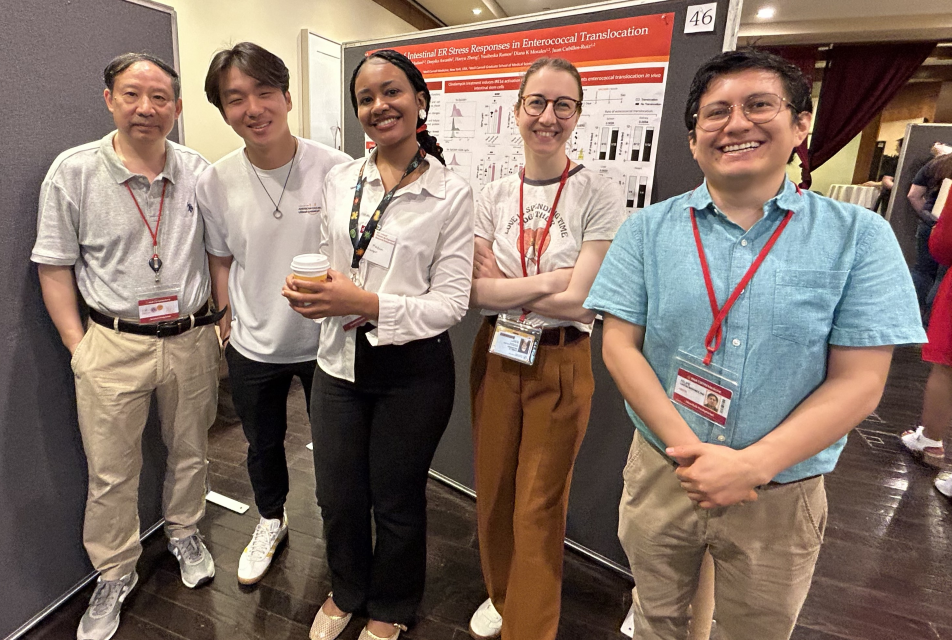
Rows of poster boards filled the Griffis Faculty Club at Weill Cornell Medicine, showcasing research ranging from cancer immunology and microbiome science to the emerging field of space biology. Standing beside them, graduate students explained months of work in a matter of minutes, fielding questions from judges, faculty and peers.
The 45th annual Vincent du Vigneaud Memorial Research Symposium held on April 16 had a record number of 153 abstracts submitted this year, including posters and eight oral presentations. The student-organized event has become central to the Weill Cornell Graduate School of Medical Sciences' experience.

Organizers Stephanie Tam and Hayden Tharp
“It’s rewarding to see students come together, learn from each other and gain experience presenting their work,” said Stephanie Tam, a fourth-year doctoral student in the Physiology, Biophysics and Systems Biology program in Dr. Stephen Long’s lab, and event co-chair. “We spend so much time working independently, so events like this allow people to be together and reconnect.”
Logistics for the event required almost eight months of intensive preparation. Tam worked alongside Hayden Tharpe, a fourth-year doctoral student in the Pharmacology program and event co-chair, to coordinate submissions, recruit 50 volunteer judges and schedule multiple poster sessions, oral presentations, a keynote address and networking time.
“The symposium is an opportunity for students to present their research in a supportive, internal setting and receive feedback before going to external conferences,” Tharpe said. “These skills improve over time and are essential for a successful scientific career.”
Bridging Institutions and Building Community
The research showcase brings together students and faculty from across Weill Cornell’s eight graduate programs and affiliated laboratories.
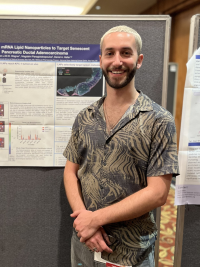
Leon Wagner
Leon Wagner, a second-year pharmacology student in Dr. Daniel Heller’s lab at Memorial Sloan Kettering, presented his poster on targeting pancreatic ductal adenocarcinoma, one of the deadliest cancers with a five-year survival rate of less than 10% and often diagnosed at an advanced stage.
“It is a challenging cancer with great patient need. I felt it was important to focus on this area,” said Wagner. With his background in biomedical engineering, his research aims to refine targeted therapies for tumors that currently resist standard treatment.
This year’s program included 21 posters from graduate students based at Houston Methodist, a longstanding Weill Cornell academic affiliate and an official campus for doctoral training in physiology, biophysics and systems biology since 2021. A joint neuroscience PhD program was added in 2023.
Marisela Martinez de Kraatz, a third-year neuroscience student in Dr. Robert Krencik’s lab at Houston Methodist Research Institute, said an interest in neurodegenerative disease grew from her experience helping care for her grandfather. She is investigating how astrocytes, the brain’s support cells, might protect neurons from the ravages of Parkinson’s disease. Martinez de Kraatz is using stem-cell-derived models of the midbrain to investigate whether these cells can actively slow neurodegeneration and move treatments beyond symptom management toward halting disease progression.
“Being part of the very first neuroscience cohort at the Houston satellite campus and sharing this work in person in New York has been an incredible learning experience,” Martinez de Kraatz said.
Next Generation of Scientific Leaders
Presenters receive feedback from volunteer judges, who are postdoctoral researchers and faculty members. Two judges provide evaluations and scores for each presentation with the best oral and poster presentations winning awards, which are presented at Convocation in May.
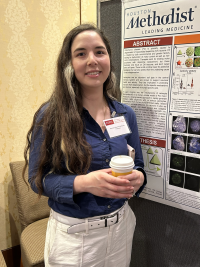
Marisela Martinez de Kraatz
Students review the comments with mentors to help strengthen future presentations. “We made a special effort to make sure presenters received useful feedback in a timely way,” Tam said.
This year, the students selected Dr. Rachel Perry, associate professor of cellular and molecular biology at Yale School of Medicine, as the keynote speaker. She shared her research about the relationship between insulin and cancer. Organizers said her commitment to mentorship, along with the broad relevance of her research on metabolism and disease, made her a strong fit for the symposium.
The day concluded with a reception where students continued exchanging ideas and connected with alumni from academia and industry.
“Since its inception 45 years ago, this symposium has always been organized by and for our doctoral students to serve a greater purpose—providing our students the opportunity to present their research to peers, mentors and faculty, and demonstrate their tremendous promise,” said Dr. Barbara Hempstead, dean of Weill Cornell Graduate School of Medical Sciences.
The symposium honors Dr. Vincent du Vigneaud, Nobel laureate and former chair of the Department of Biochemistry at Weill Cornell Medicine, who was passionate about education and student research.
Top First Year Posters
Nolan Caile, Dr. Effie Apostolou’s lab: Dissecting the role of histone acetyltransferase CBP/p300 on the transcriptional and architectural establishment of cell-type specific programs following cell division
Cheyenne Bright, Dr. Cesar A. Arias: A locus-level bioinformatics framework for quantifying 23S rRNA copy number and linezolid resistance mutations in enterococcus faecium
Top Posters (2nd year and above)
Aakanksha Rajiv Kapoor, Dr. Vivek Mittal’s lab: Novel insights into the immunoregulatory role of radiation activated club cells in non-small cell lung cancer
Esther Lee, Dr. Morgan Huse’s lab: Mechanical licensing of cytotoxic degranulation
Guillermo Hoppe-Elsholz, Dr. Cesar A. Arias: Transferable B-lactam resistance in multidrug-resistant enterococcus faecalis (Efs) via truncation of pbp4 and acquisition of a novel PBP (PBP-4a) gene
Margarida Rosa, Dr. George Khelashvili’s lab: A molecular mechanism of Li⁺ inhibition of MFSD2A mediated lysolipid transport
Matthew Fiedler working, Dr. Francisco Altamirano: Recapitulation of tissue-scale ventricular tachyarrhythmic mechanisms in human engineered heart tissues
Sandy Rajkumar, Dr. Yicheng Long’s lab: BEND3 regulates polycomb-mediated epigenetic repression during development
Ziqi (Christine) Yu, Dr. Andy Intlekofer’s lab: Targeting cytosolic mutant IDH1 by hyperactivation to induce cancer cytotoxicity
Aliya Holland, Dr. Morgan Huse’s lab: Mechanosurveillance of Senescent Cells
Oral Presentations
First Place: Bjoern Perder, Dr. Jingli Cao’s lab: Hypoxia-activated scleraxis guides perivascular differentiation of epicardial progenitors in heart development and regeneration
Second Place: Richard Garner, Dr. David Rickman’s lab: FOXA2 reprograms androgen signaling to promote lineage plasticity in advanced prostate cancer
Third Place: Charlie Warren, Dr. Jacob Geri’s lab: Profiling Ubiquitin Interactions and Affinities