


In the early aughts, when anesthesiologist Dr. Gunisha Kaur, M.D. ’10, was a medical student at Weill Cornell Medicine, she sought to help immigrants who were seeking refuge in the United States after experiencing persecution or torture in their home countries. It’s a passion drawn from a profoundly personal experience: As a daughter of Indian immigrants and an immigrant herself, she wanted to find a way to help people like her father, a Sikh who had been beaten by a mob in India and left for dead. Unfortunately, there was no forensic evaluation clinic to document asylum seekers’ injuries at Weill Cornell at the time.
That changed the year she graduated, when students at Weill Cornell Medical College launched the Weill Cornell Center for Human Rights (WCCHR) in collaboration with Physicians for Human Rights, a Nobel Peace Prize-winning nonprofit that leverages medical and scientific expertise to document and combat global human rights violations.
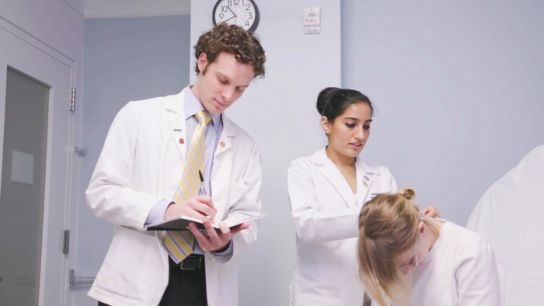
In this 2018 photo, Dr. Gunisha Kaur, right, conducts a mock forensic evaluation alongside Dr. Andrew Milewski, left, then a Weill Cornell Medicine student and now WCCHR co-medical director.
While at the time there were medical schools teaching forensic evaluation techniques, WCCHR was the first asylum clinic at a United States medical college run by students with faculty oversight. Its existence has since spawned dozens of student-led clinics, hundreds of research studies and thousands of forensic evaluations that changed the course of countless lives.
“The Weill Cornell Center for Human Rights is one of the most unique opportunities that the medical school offers,” said Dr. Kaur, who is now an associate professor of anesthesiology at Weill Cornell Medicine and a center medical director. “And what's really exciting about the work and the research that we're doing is that it covers Weill Cornell Medicine's tripartite missions: care, discover and teach. The clinic is just wide open, really, for people to do research, to discover and to create work that leaves an impact.”
A Matter of Life or Death
The impact could be seen last October, when a group of more than 100 medical students, physicians, lawyers and asylum advocates gathered for the 2025 Immigration & Asylum Medicine Summit, presented by the WCCHR.
The summit’s keynote speaker, Jafar Novruzov, highlighted the ever-increasing challenges asylum-seekers face. As a board-certified psychiatric nurse practitioner and a client of WCCHR a decade ago, he speaks from experience.
Novruzov, who applied for asylum from Azerbaijan, said he received culturally informed care and evaluation. “The way they approached me, the way they took their time, they didn't rush me in the process and gave me space,” he said. “The center made me feel safe and just as important, I was able to share the trauma and feel like somebody cares.”
The WCCHR provides survivors of persecution or torture seeking asylum in the U.S. with objective forensic evaluations, which are psychological and physical assessments, including gynecological exams, that can last up to three hours. Since its inception, the center has evaluated more than 1,100 people.
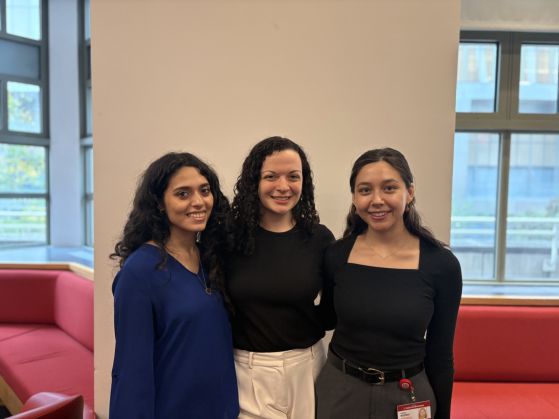
WCCHR's student co-executive directors. From Left: Sarah Chowdhury, Elizabeth Bundschuh and Sarah Wozniak.
“We’re assessing them from a medical perspective, and confirming that yes, they have PTSD or depression, scars or proof of torture or injury,” said fourth-year medical student Elizabeth Bundschuh, who is a co-executive director at the WCCHR along with fourth-year students Sarah Chowdhury and Sarah Wozniak. “Their lawyers can then use the evaluation reports as evidence in their asylum application.”
The detailed affidavits help judges make decisions on who remains in the country. With the national asylum grant rate at a mere 35% as of 2024, such examinations can mean the difference between life and death, said fourth-year medical student and fellow co-executive director Sarah Chowdhury. In fact, the asylum grant rate increases to nearly 82% after undergoing forensic medical evaluations, found a 2021 study in the Journal of Forensic and Legal Medicine.
A Unique Beginning
WCCHR was founded in 2010 by a small group of medical students, led by Shelli Farhadian, who became the first executive director, advised by a team including volunteer physicians and other health care professionals, who helped people from around the world escaping persecution due to race, gender, religion, sexual orientation and political affiliation.
The center has come a long way from its roots, said Dr. Joanne Ahola, a psychiatrist who’s been involved with the program since its inception. Dr. Ahola, a clinical assistant professor of psychiatry at Weill Cornell, was one of the center’s founding medical directors, helping to refine the program’s structure. “It was a dream come true for me to work with the WCCHR,” she said. “I jumped at the chance.”
With Dr. Ahola and two other doctors on board—OB-GYN Terry Edersheim and internist Dr. Nicole Sirotin, joined later by psychiatrist Dr. Thomas Kalman—the students got to work. Then-first-year student Eleanor Emery became the second official executive director and worked off the blueprints that previous students, including Shelli Farhadian, now at Yale, laid out to overcome the challenges of establishing the first-of-a-kind center.
“Bearing witness to the stories of asylum seekers has had a profound impact on me,” Dr. Emery said. “Documenting evidence of past persecution remains crucially important despite the ongoing attacks on the asylum system. In addition to providing an invaluable service, it's an incredible learning opportunity. Teaching aspiring medical professionals how to perform trauma-informed exams gives them skills and knowledge that often aren't well taught in medical school and better prepares them to care for all patients."
After handling several cases successfully, Dr. Ahola said, “we then began taking on cases that weren’t easy. We took cases that had been turned down already. We had unaccompanied minors. We took on tight timing cases and turned them around in 48 hours.”
With support from early faculty champions, including Dr. Oliver Fein, then-associate dean for affiliations, the center developed a formal advisory board and sustainable structure. The results were inspiring: Every asylum-seeker evaluated during the clinic’s first five years was granted asylum.
While its processes have matured, the center still uses space and exam rooms borrowed from Weill Cornell’s Clinical Skills Center, showcasing its work in front of the entire school. Today, WCCHR works with 50 active evaluators from Weill Cornell’s faculty and continues to train new generations of students.
Tougher Times Ahead
Despite all that it has accomplished, WCCHR’s work is getting more difficult, said Bundschuh, as the current political climate becomes more fraught with a hold on all pending asylum applications.
The center is responding by redoubling its efforts. During the Immigration and Asylum Medicine Summit in October, two speakers from Physicians for Human Rights spoke to the students about the uncertain and evolving immigration climate. The center also hosted a career panel to expose medical students to careers in human rights.
In addition to the summit, clinic members are teaching interested medical students and licensed clinicians how to evaluate victims of torture, identify the physical and psychological sequelae of abuse and write affidavits documenting their findings. Further activities include a speaker series with human rights experts; monthly small group case-based learning discussions for students and faculty; and “know your rights” trainings. Another arm of the clinic is conducting research on case outcomes and quality improvement.
Recently, the WCCHR expanded its educational programming for medical students, health professionals, and other schools and universities to create more opportunities. It also cemented a cross-campus collaboration with the Cornell Law School, funded by Weill Cornell Board of Fellows member Paul Salvatore and his wife, Pamela.
Moreover, WCCHR leads a robust Continuing Care arm that provides asylum-seeking clients with social, medical and legal resources after their evaluations. Some of this work has gone virtual to protect clinic clients.
Many of the people trained at the WCCHR have stayed active within asylum medicine, Dr. Ahola says. Dr. Emery, for example, launched a series of asylum medicine programs at Massachusetts General Hospital, UCLA and Cambridge Health Alliance. Today, she co-leads the Asylum Medicine Training Initiative, an 80-expert working group that developed a virtual, peer-reviewed asylum medicine curriculum. “Teaching aspiring medical professionals how to do trauma-informed exams gives them skills and knowledge that they don’t learn in medical school,” she said.
It is this expertise to care for this very vulnerable population that all the current and past clinic co-directors and advisors are so proud of, Dr. Ahola said. “People use our program as a model, and we train other schools to do this vital work,” she said. “What you end up with is highly motivated, fantastic students who are optimistic and hard-working and can make an impact.”