

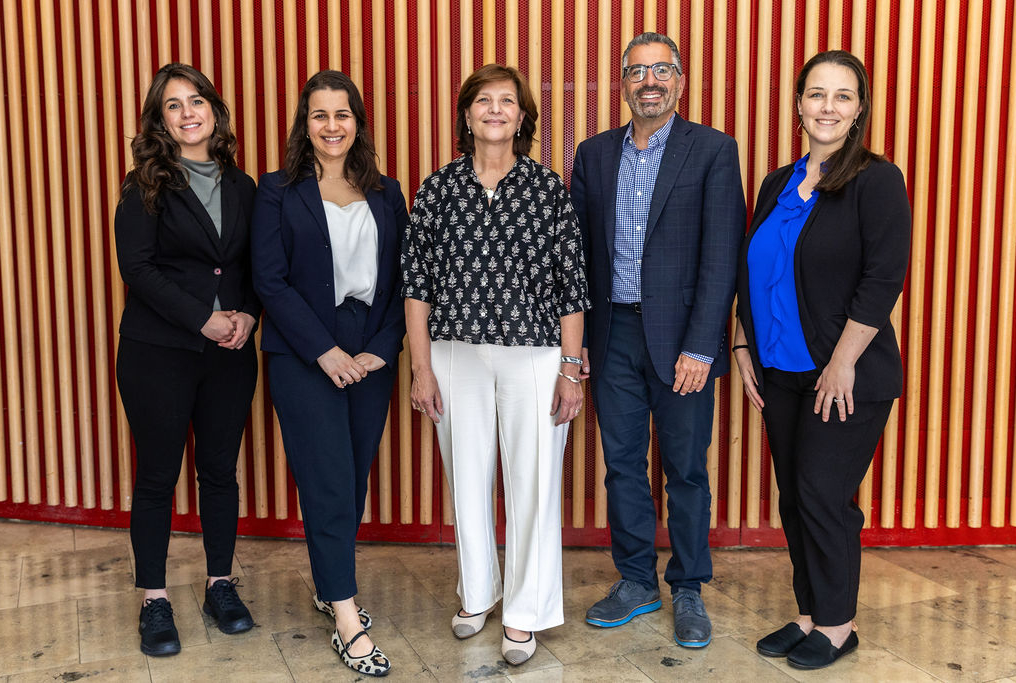
More than 150 educators gathered in person and virtually May 16-17 at Weill Cornell Medicine for the OneCornell Health Educators Conference. The inaugural event, titled: “From Assessment to Feedback: Closing the Loop in Clinical Education in the Health Professions,” convened educators and students from medicine, veterinary medicine, physician assistant studies and licensed veterinary technician training for two days of medical education programming.
The hybrid event was jointly organized by education leadership from Weill Cornell Medicine, Cornell’s College of Veterinary Medicine and Weill Cornell Medicine-Qatar, pairing the educational strengths and innovations of their institutions.
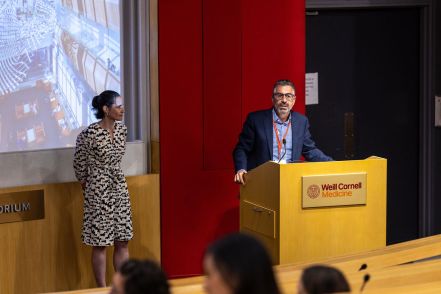
Dr. Joseph Safdieh introduces keynote speaker Dr Verity Schaye from NYU Grossman School of Medicine.
“Bringing together medical educators from medicine and veterinary training pathways allowed us to expand our horizons and think broadly about medical education and the challenges we can solve together to prepare the next generation of health professions educators,” said Dr. Joseph E. Safdieh, conference co-chair and the Richard P. Cohen Senior Associate Dean for Education at Weill Cornell Medicine. “Attendees came from as far as Hong Kong, Qatar and Brazil. It was a capstone to the amazing work we’ve done this academic year to bring our campuses together as one Cornell community of educators.”
The conference emanated from Weill Cornell Medicine’s Educators Driving Growth & Excellence (EDge), a new initiative from the Office of Medical Education and the Cornell Veterinary Educators Academy, and was made possible through a generous anonymous donation from a grateful patient treated by Weill Cornell alumna Dr. Shari Midoneck. The conference focused on the themes of teaching diagnostic and clinical reasoning and best practices for providing learners with effective assessment and feedback. It also featured interactive educator panel discussions and workshops, and selected abstracts from around the world for oral presentation that sparked an exchange of ideas.
“The conference highlighted how similar the educational questions and challenges are across disciplines, regardless of whether students are training to care for humans or animals,” said Dr. Julia Felippe, conference co-chair, associate dean for community engagement and executive director of the Cornell Veterinary Educators Academy at Cornell’s College of Veterinary Medicine, located on the university’s Ithaca campus. “There was so much energy in the room, with a lot of great questions, audience participation and captivating speakers.”
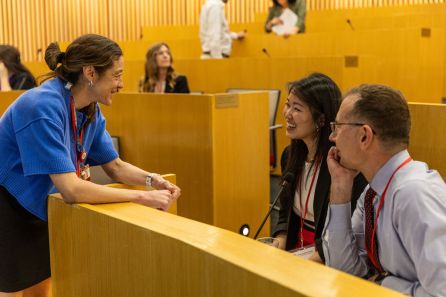
Dr. MacKenzi Preston, left, from Weill Cornell Medicine chats with Dr. Alice Tang, center, from Weill Cornell and Dr. Ricardo de Matos, right, from the Cornell College of Veterinary Medicine.
Anchoring the event were three keynote speakers: Dr. Subha Ramani, associate professor of medicine at Harvard Medical School and associate physician in the Division of General Internal Medicine and Primary Care at Brigham and Women’s Hospital; Dr. Verity Schaye, associate professor of medicine at NYU Grossman School of Medicine; and Dr. Thilan Wijesekera, director of clinical reasoning and of performance improvement at Yale School of Medicine.
Dr. Ramani kicked off the conference with a presentation that showcased her perspective as a seasoned educator in the field. With insights into the past, present and future of medical education, she offered a framework for navigating today’s challenges.
Among other conference highlights included Saturday’s Educators Panel: “From Assessment of Learning to Assessment for Learning: Lessons from Feedback Practices Across Disciplines,” moderated by Dr. Thanakorn Jirasevijinda, professor of teaching in pediatrics at Weill Cornell Medicine.
Panelists offered perspective on how learner feedback and assessment have evolved over the past decades, with different generations of learners and how technology facilitates or hinders feedback. They discussed how critical feedback is to the learning journey and its bi-directional nature, emphasizing that to provide effective feedback, it’s important to first establish a rapport with the learners and to check in with the learner by asking questions, such as: “Tell me how you think you’re doing well and what you need to work on.” The key takeaway, Dr. Jirasevijinda said: When learners are asked to initiate feedback conversations, it can help them develop a growth mindset.
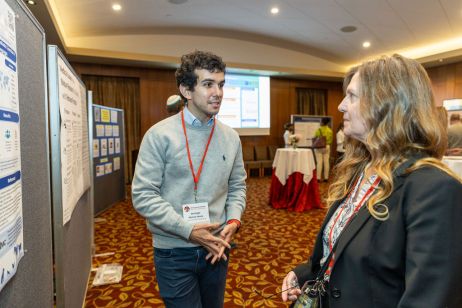
Abstract presenter Dr. Santiago Alonso Sousa, left, speaks with Dr. Jodi Korich, associate dean for education at Cornell College of Veterinary Medicine.
“We shared lessons and perspectives that underscored our similarities and differences across disciplines,” he added. “There was a lot of nodding in the room and cross-pollinating conversations and networking that may lead to improved practices and collaborative medical education research.”
Medical education and assessment are experiencing a period of accelerated change, driven by the emergence of artificial intelligence. Dr. Schaye launched Saturday afternoon’s agenda with a keynote address discussing the role of artificial intelligence in clinical reasoning assessment and how it can innovate as change agents in medical education. She introduced the key concepts of deskilling, meaning that one loses a skill because it’s been given to AI; upskilling, in which users employ AI to improve performance and increase skills; and never-skilling, which are skills that no longer need to be taught because AI can do it. Dr. Schaye left educators with a key takeaway: AI can help us improve what we do, but clinical reasoning must always live with the clinician.
Other notable aspects of the conference included the interactive workshop: “Better Questions, Better Learning: Coaching Skills for Educators,” followed with a discussion on advising versus coaching, hosted by Dr. Alice Tang, assistant professor of clinical medicine at Weill Cornell Medicine, and Ricardo de Matos from the Veterinary College, who discussed the school’s innovative coaching system.
The conference wrapped up on Sunday with a keynote presentation from Dr. Wijesekera, who discussed how prognosis and management fit into the future of clinical reasoning, followed by an interactive workshop on the practical approach to creating high-yield medical education scholarship.
Overall, the first-of-its-kind conference, which offered attendees the opportunity to learn from the world’s best educators at the intersection and veterinary education, was so well received that it’s likely to become an annual event, alternating between New York City and the Ithaca campus Dr. Safdieh said.
“The interest for this event was already there,” he said. “We just provided the structure.”