

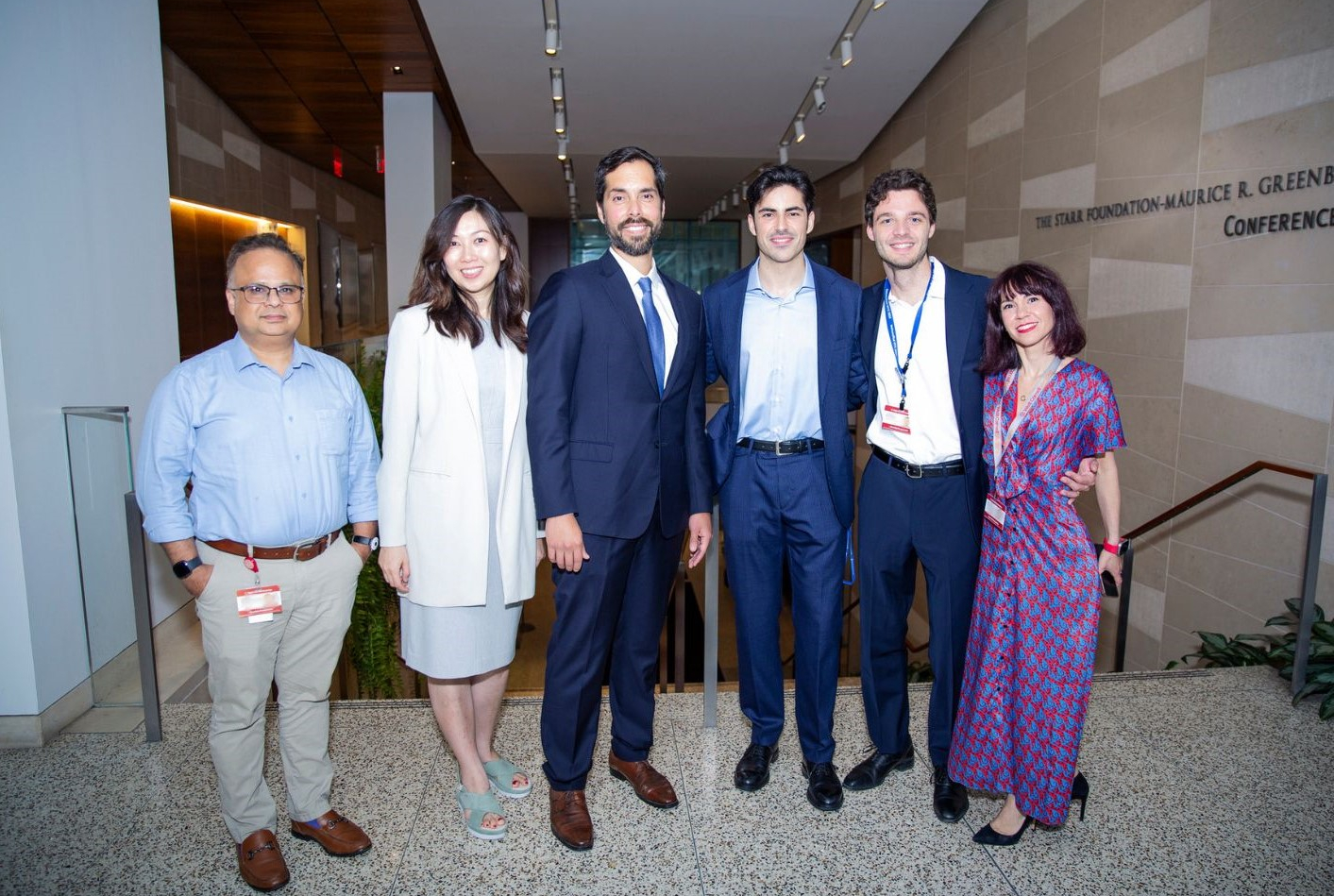
The eighth cohort of the Biomedical Innovation Challenge showcased its innovations and development plans during a lightning round of pitches and judges’ questions on June 4 in the Belfer Research Building.
The annual event serves as the culmination of BioVenture eLab’s entrepreneurial education program for Weill Cornell faculty and trainees who aspired to take the next step in translating their discoveries into fundable early-stage innovation projects. This year, five teams presented their innovations, as well as their plans to navigate the commercialization journeys ahead to catalyze their research into products aimed at changing patients’ lives.
“Innovation doesn't happen unless scientists and clinicians are willing to learn something new, to think differently and to pursue solutions beyond the current standard of care,” said Loren Busby, director of BioVenture eLab, noting how this latest class had evolved from researchers into entrepreneurs after completing the program. “This is the definition of entrepreneurship on which we rely in our program.”
In this year’s competition, three teams tackled commercializing cell therapies, and two others pitched their AI-related technologies for the first time to a panel of investors and industry judges.
The competitors included:
- AdherePath, led by Dr. Samprit Banerjee, which taps into AI to help patients with depression adhere to their treatment
- ASTRA, conceived by Dr. Judy Zhong, automates clinical trial workflow through AI
- Nodera Biotherapeutics, based on work by Dr. Jonathan Villena-Vargas, engineers lymph nodes-derived T cells as a novel approach to attack solid tumors
- Storgan Therapeutics, represented by Drs. Anna Ada Dattoli and Shahin Rafii, turns gastric stem cells into a cell therapy for treating Type 1 diabetes
- Styr Therapeutics, led by Drs. Carlo Bosi and Giovanni Medico, is working to advance a target-focused take on CAR-T cell therapy for solid tumors.

Panel of judges. From left: Drs. Carlo Yuvienco, Brandy Houser and Matias Porras Paniagua.
Judging this field of scientist-entrepreneurs were three experts trained in biomedical technology and engineering and experienced in investing and launching life science startups: Dr. Brandy Houser, co-founder and CEO of immunotherapy firm Traverse Biotech; Dr. Matias Porras Paniagua, vice president on the investment team at growth equity firm Insight Partners; Dr. Carlo Yuvienco, the inaugural director of Ford Center Incubator at The Rockefeller University. Following each presentation, the judges pressed founders on details about their business models and exit plans, FDA approval pathways, and deeper dives on the science behind some of the findings.
First place, along with a $20,000 prize, went to Styr Therapeutics, whose work addresses the efficacy bottleneck in solid-tumor CAR-T treatment. The Styr team identified 4-1BBL as a biomarker and potential target in multiple solid tumors using a discovery engine that uncovers tumor-exclusive targets. With this discovery, Styr Therapeutics has developed a CAR-T candidate that outperforms current lymphoma therapy in early mouse studies. Styr Therapeutics is looking to perform safety and toxicology studies and raise $5 million to start, with another $7 million for later phases. “We’re advancing the next generation of CAR-T cell therapeutics to the clinic. We’re doing so by building a novel scientific discovery engine and identifying the most appropriate targets for solid tumors,” said Dr. Bosi. Dr. Medico believes the technology is well-placed to go far within the sector. “The fact we’re starting from a platform, and then we’re reducing it to direct our therapy to a target, is one of the advantages of the approach we’re taking,” he said. The platform can be repurposed to build a pipeline of multiple assets.

First place team Styr Therapeutics, represented by Drs. Giovanni Medico (left) and Carlo Bosi.
There were two runners-up, each winning $10,000. Nodera Biotherapeutics is able to manufacture stem cells from lymph nodes within a couple of weeks. The concept is seeking funding and expects to start Phase 1 testing in the next 18 months at Weill Cornell. ASTRA leverages AI agents to automate the clinical trial process across existing, fragmented tools from submitting studies for IRB approval, locating possible participants for screening to data input and management. Finished with Phase 1, which included the core architecture and user interface, the project will need $5 million to move into Phase 2 to test enrollment and then Phase 3 for a large-scale pharmaceutical trial.
Turning a scientific finding into a viable commercial product requires perseverance, Busby noted. It’s a defining trait needed to transform an idea or breakthrough into patient impact.
“I encourage everyone to remember that the true value extends far beyond the cash awards, and success is not defined by a single pitch,” she said. “Rather, it's built through persistence, learning, collaboration and a willingness to continue moving forward.”

Nodera Biotherapeutics, represented by Dr. Jonathan Villena-Vargas (left), and ASTRA, represented by Dr. Judy Zhong, tied for second place.
The BioVenture eLab program exemplifies this approach. Each participant attends weekly sessions that help them develop the critical skills needed to successfully commercialize scientific findings, from gauging the current market needs to navigating regulatory details specific to their niche. Teams are matched with industry mentors who also advise and refine their strategies, then work with them to craft succinct pitches to venture capital and industry judges.
“Commercialization of academic innovations is important to advancing healthcare and fueling further discoveries,” said Dr. Lisa Placanica, senior managing director of the Center for Technology Licensing at Weill Cornell Medicine. “Here at Enterprise Innovation, we cultivate the entrepreneurial mindset and skills of our researchers and clinicians with programs like this to prepare them for working with industry collaborators and potential investors.”