

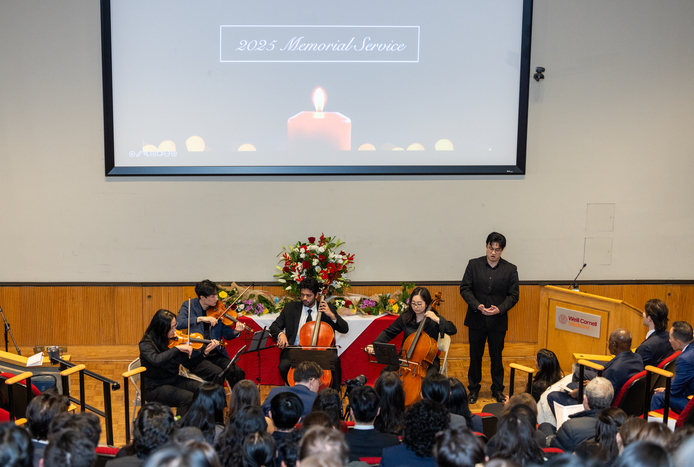
As first-year Weill Cornell Medical College student Sarah Mansour memorialized 28 people who donated their bodies to the institution’s Gross Anatomy program, she quoted a passage from the novel Gilead by Marilynne Robinson that she said served as a perfect testament to the donors’ ultimate gift.
‘“There is a kind of patience that comes from believing the future will remember us kindly, even if it does not remember us by name,’” said Mansour, reading the passage during Weill Cornell’s annual Gross Anatomy Memorial Service, held Dec. 10 in Uris Auditorium. “‘What is given freely does not disappear. It continues in the lives of others, unfolding slowly, often long after the giver is gone.”
While the 28 people who donated their bodies to Weill Cornell Medical College couldn’t be more different -- the 14 men and 14 women ranged in age from a 63-year-old professor to a 100-year-old homemaker -- they all had one thing in common: A selfless dedication to teaching the next generation of physicians, for which they will always be remembered.
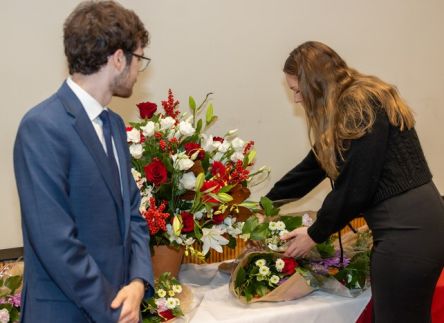
Medical students lay memorial flowers honoring donors.
During the service, hosted by the Department of Radiology's Division of Anatomy, medical students and faculty members, along with religious speakers, paid their respects to the donors and their families. Table by table, the students came up, gave moving tributes and placed flowers under the names of the donors. The flowers were given to the donors’ families at the end of the event.
The moving, nearly two-hour program was a living example of the deep gratitude Weill Cornell medical students feel for the people they called, time and again, their “first patients.”
Attended by close to 200 people, the memorial service invited each of the 106 first-year medical students on stage to thank the donors’ families for the “irreplaceable role” their loved ones played in their education. The students showed their gratitude with heartfelt speeches, recitation of poetry and literature, and musical tributes.
The donors’ generosity benefitted more than just first-year students, too, said Dr. Estomih Mtui, chief of the Division of Anatomy and professor of anatomy in radiology. “For the past 16 weeks, I've seen our first-year medical students, as well as residents in surgery, ENT, dermatology and OB/GYN, acquire new and important knowledge because of these gifts--knowledge that will directly benefit countless future patients,” he said.

Dr. Estomih Mtui, chief of the Division of Anatomy, addresses the audience at the ceremony.
While the students still have years of work to complete before they become doctors, the donor memorial marks a threshold for the students, representing their transition from laypeople to health professionals, Dr. Robert Harrington, the Stephen and Suzanne Weiss Dean of Weill Cornell Medicine, said. The ceremony and their work with the donors are also touchstones that they could go back to time and again during their careers, he added.
“Medicine is a human art built upon scientific principles that's different than science alone,” he said. “In addition to the science of pathology and physiology that you've learned over the past weeks, I hope you've also learned empathy, respect, civility, how to work in teams, because these are the lessons that will sustain you throughout the course of a long career.”
The students are in a unique position thanks to the donors as well as the Gross Anatomy Program they support, said Dr. Joseph Safdieh, senior associate dean for education at Weill Cornell Medicine, since some medical schools are moving away from using human cadavers in favor of virtual reality. During his remarks, he reminded them that their journey with the donors as their partners is truly revolutionary.
“While students [attending virtual reality anatomy classes] can still meet the same cognitive learning objectives and pass the same multiple-choice tests, something essential is lost,” he said. “What happens in the anatomy lab is not simply intellectual learning. It's transformational, because in anatomy, you do meet your first patient, a patient who somehow teaches you everything without saying a word and without taking a breath.”
Medical student Angela Youn said working with the donor bodies “humbled” her and made her grateful for the education she is getting at Weill Cornell Medical College. “The lab really teaches us to humanize the patients we interact with and really see them beyond just patients, but as human beings with full, fulfilling lives.”
Jane O’Keefe, who passed away at age 82 in February 2024, was one such patient. O’Keefe, who saw doctors at Weill Cornell during her life, was an interior designer who became a therapist in her 60s. She decided to donate her body to Weill Cornell Medical College after her friend signed up with the donation program. She believed in science and wanted to make a difference, her brother Richard O’Keefe explained.
“I was a little hesitant at first but being here today,” he said, “I feel really good about what she was able to contribute, even after she passed.”